

- Blog >
- Remember When the Internet Looked the Same Everywhere?
Remember When the Internet Looked the Same Everywhere?



Key Takeaways
- Geoblocking restricts content or access based on location, checked via IP address or GPS.
- It exists for licensing and copyright reasons, legal compliance, regional pricing, and security; there’s no single cause.
- VPN detection evolved specifically to catch and block the most common way people route around geoblocks.
- Detection methods now go well beyond a simple IP blacklist; traffic patterns, device fingerprints, and location and time mismatches are all in play.
A page online used to just be a page online. A video was a video, the same one, wherever it was opened. Then, "not available in your region" started appearing on things that load perfectly well one border over, and it kept appearing: on more websites, in more countries, for more reasons.
The open internet didn’t close all at once. It got mapped, licensed, and fenced one border at a time, and most people never even noticed the fences going up.
What Geoblocking Actually Is
Geoblocking is a technology that restricts or blocks your access to content, websites, or apps based on a user's physical location. The mechanism is simpler than most people assume: a website looks at the IP address a request arrives from, checks that address against a commercial IP geolocation database, and decides what content to deliver. Mobile apps can go further and read the GPS coordinates directly from the device you’re using.
IP geolocation databases are the load-bearing piece of the puzzle. They’re third-party commercial products that map IP address ranges to countries, regions, and sometimes cities, assembled from registry records, ISP routing data, and inference. These databases are accurate at the country level most of the time and considerably less accurate when it comes to the nitty-gritty, which is why a website may occasionally decide someone is in the wrong country for no apparent reason.
Why Geoblocking Exists
- Copyright and licensing: A studio sells streaming rights country by country, so a platform holds a show in one market and not another. The catalog difference isn’t a technical limitation – it’s a contract, and geoblocks exist to enforce it.
- Legal and regulatory compliance: Data protection law, gambling regulation, and sanctions (including OFAC) require companies to restrict access in specific jurisdictions. This is a legal obligation with real penalties attached, not a business preference.
- Regional pricing: The same software, subscription, or game sells at different prices in different markets, and geoblocking is what stops customers from shopping across the border to save money. Sometimes, this reflects genuine purchasing-power differences. Sometimes, it reflects what a market will tolerate.
- Security and fraud prevention: Blocking online traffic from regions associated with high fraud or attack volume is a standard risk-reduction measure. It’s also the reason a lot of legitimate users in those regions get blocked from services that have nothing to do with them.
How the Open Web Got Fenced Off: A Timeline
| Year | Event |
| January 2007 | Netflix launches streaming to U.S. viewers |
| July 2007 | BBC iPlayer launches for UK license fee payers |
| March 2008 | Hulu launches streaming of major TV shows and movies, strictly restricted to U.S. viewers |
| September 2010 | Netflix launches in Canada amidst concerns for internet download speeds in comparison to the U.S |
| 2010-2015 | The golden age of VPNs: As streaming platforms geoblock content, consumer VPNs are positioned as an easy fix. |
| January 2016 | Netflix goes global, expanding to roughly 190 countries. It also announces it will block users connecting through proxies and VPNs. |
| December 2018 | The EU enforces regulations prohibiting unjustified discrimination by location for many goods and services. Nice right? Not so much. The rules exclude what it calls “audiovisual content” – streaming services. |
| November 2019 | Disney+ launches for viewers in the U.S., Canada, and the Netherlands. VPNs won’t help outsiders, as local payment options give your location away. Ask me how we know! |
| 2020’s | Streaming platforms get serious about detecting and instantly blocking VPN traffic; mainstream providers with datacenter IPs struggle. In contrast, providers with residential IPs are increasingly helpful. |
| 2022–2023 | Netflix began cracking down on password sharing, and geoblocking enforcement gets granular. Household-level and device-level data is now monitored to determine location, and IPs become only one signal among several rather than the whole check. |
| September 2024 | Disney+ launches its global password crackdown. Rolling out across the U.S., Canada, Europe, and Asia-Pacific, it restricts access to a single residential household, |
| 2024–2026 | Services like Spotify and YouTube Premium are rolling out household plans, restricting password sharing and enforcing granular geoblocking. Also, a growing number of services are considering joining the password-sharing crackdown wagon, including HBO Max. |
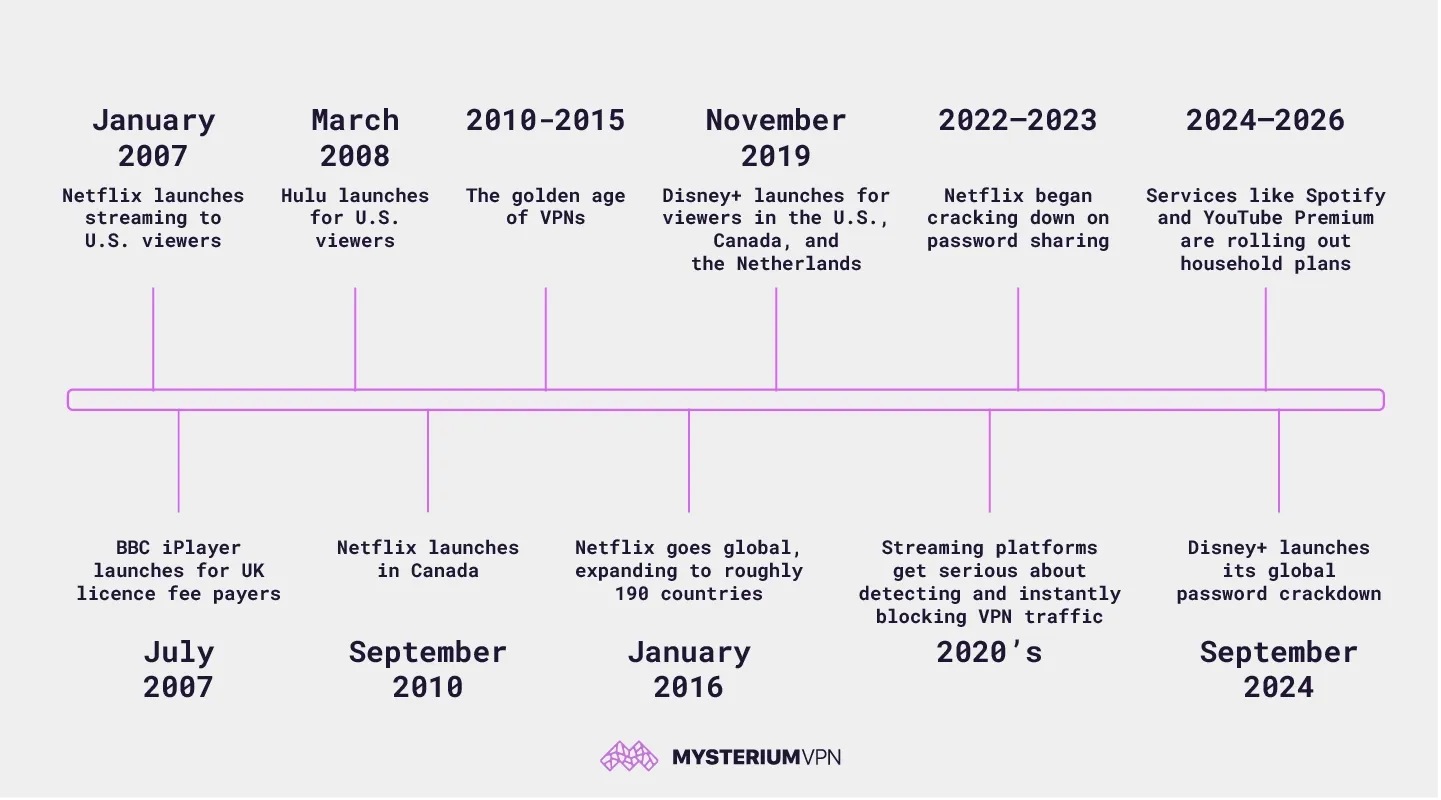
What Changed Wasn't the Technology
Look at that timeline again and find what’s missing: any change to how the internet actually works. A URL resolves the same way it did back in 2005. DNS still answers, packets still route, HTTP still returns a page. Nothing in the plumbing decided that a video should play in Toronto and not in Detroit.
What changed is the default. For roughly the first fifteen years of the consumer web, the answer to "can I open this" was yes, and the exceptions were rare enough to be notable. Now the answer is – it depends, and the exceptions are the architecture. Every entry in that table is a business or legal decision that got implemented as a technical check, and each one seemed reasonable to whoever signed off on it.
That’s how defaults reverse. Not with a decision anyone announced, but with twenty years of individually defensible checks, each added by a different company for a different reason, arriving at a web where the first question a website asks you is where you are.
The Detection Arms Race
VPN detection is the set of techniques that websites use to determine if your connection is coming through a VPN or proxy rather than directly from your own network.
Because changing your virtual location is the obvious answer to geoblocking, platforms under licensing pressure needed a countermeasure. That’s how VPN detection came to be, through four main methods:
- Datacenter IP blacklisting: Most commercial VPNs offer datacenter IPs; their ranges are publicly documented in registry records. When a website identifies the IP as VPN traffic, it’ll be blocked. This is the cheapest check available and still the most widely used.
- Traffic and density analysis: When hundreds or thousands of sessions arrive from a single IP address, that address no longer resembles a household connection. Concurrent-session counts, request volume, and the sheer number of distinct accounts behind one IP are all measurable without inspecting any content.
- Location, time, and language mismatches: An IP address that geolocates to one country, paired with a device reporting a different time zone, a foreign language, or a different payment method, raises red flags. No single mismatch proves anything, which is why these are usually scored rather than treated as a verdict.
- IP and DNS leaks: WebRTC, misconfigured DNS resolution, and other data leaks can expose your location even while the main VPN connection is successful. This is a configuration failure rather than a detection technique in itself, but sites absolutely read the result.
So, is it possible to detect a VPN? Yes, frequently, though not always reliably. Detection produces a probability, not proof, and every site decides for itself where to set the threshold.
The Countermeasures to Geoblocking
Two responses have emerged on the other side of this, and both are worth describing plainly rather than recommending.
Residential proxy services route traffic through real home internet connections rather than data center servers: the IP address belongs to a residential ISP, because it’s a residential ISP address. As such, it’s not in a data center IP database that gets blocked as soon as you open a website.
Separately, obfuscated protocols disguise VPN traffic so that it resembles ordinary HTTPS on the wire, which targets protocol-level identification rather than address reputation. Both are documented industry practices with legitimate uses, including in regions where VPN use is itself restricted. Neither is a solution to any specific platform's terms of service, and this page is not the place to look for one.
Where Mysterium VPN Fits
Unlike standard VPN providers and their data center IPs, Mysterium VPN is built on residential IPs. Want to know how Mysterium's residential network works?
Our residential IPs are supplied by independent node operators who have explicitly agreed to participate – we offer 7,500+ residential addresses across 100+ countries, running on decentralized network infrastructure rather than a company-owned data center fleet.
Traffic from a residential IP in the address appears more similar to ordinary residential traffic, and it may be less likely to trigger VPN-specific blocks that work by identifying hosting ranges.
However, it’s not a universal fix. VPN detection keeps improving, platforms have no plans to loosen their regulations, and content availability inevitably depends on the platform, location, IP reputation, and usage pattern.
Any VPN provider claiming otherwise is sacrificing honesty for marketing. The honest version isn’t as black and white: a residential address removes the single cheapest method to get flagged.
Where This Goes From Here
The fences aren't coming down anytime soon. Licensing will keep molding catalogs by territory, compliance will keep drawing legal borders across a network that was built not to have any, and detection will keep tightening until the false positives cost more than the enforcement saves.
Streaming fragmentation is part of the same access problem, consent walls are another piece of the same fragmented web, and identity checks are becoming part of this too as age verification spreads from adult sites to app stores and operating systems.
Each of those arrived separately, for a reason someone could defend; together, however, they add up to a web where the first question every website asks is who and where you are. That’s the argument behind Nothing to Prove: the burden quietly inverted, and people now spend their time demonstrating eligibility to services they already pay for. If you want to reclaim the internet, you can get Mysterium VPN today!
A page online used to just be a page online. It can be again, but not by accident – the internet didn't get smaller on its own. It got mapped, and maps are drawn by someone.


Reclaim the internet that took you at your word!
Get Mysterium VPN
Frequently Asked Questions
Gintarė is a cybersecurity writer at Mysterium VPN, where she explores online privacy, VPN technology, and the latest digital threats in editorial pieces. With hands-on experience researching and writing about data protection and digital freedom, Gintarė makes complex security topics accessible and actionable.
Related Articles
.png)